Pink Fire Pointer Automotive Engineering
Showing posts with label Concept Car. Show all posts

2010 Citroen Sports Car Concept GQbyCitroen

French automaker Citroen has just unveiled the latest details of a new brand concept car, the GQbyCitroen, designed for the compact sports car segment. The latest concept was developed in partnership with the fashion experts GQ magazine and has been designed to provide “the ultimate gentleman’s drive”. The Citroën GQ Concept was born through a unique partnership between the UK's market-leading quality men's monthly and a team of Citroën designers, collaborating to create the ultimate gentleman's drive. This is the first time a British magazine has collaborated with a car company in this way.
2010 Citroen Sports Car Concept GQbyCitroen
Responding to a brief by GQ's editor, Dylan Jones, Citroën's team, headed by British designer - and the man responsible for the new Citroën DS3 - Mark Lloyd, took a new look at the GT theme and integrated it with a typical Citroën design approach bringing Citroën GQ Concept from design outline to concept reality.
2010 Citroen Sports Car Concept GQbyCitroen
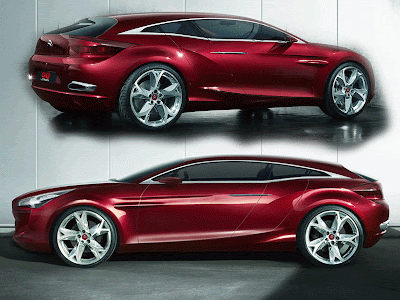
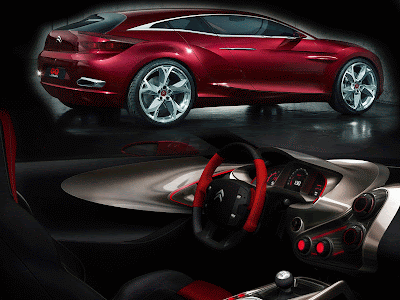
Citroën GQ Concept combines classically sophisticated features and contemporary styling with a sculpted front end, rounded rear, strong body contours and sleek concave rear windscreen - a signature Citroën design.
2010 Citroen Sports Car Concept GQbyCitroen
The car's cabin is accessed by rear coach doors and reveals a spacious, comfortable and futuristic cabin. Completing the car's bespoke styling, the interior detailing and upholstery selections were provided by Patrick Grant, the Creative Director of prestigious Savile Row tailors, E.Tautz, who commented: "Savile Row is all about balance and Tautz's simple military inspired interior is the perfect counterpoint to the Gallic flair of the exterior."
2010 Citroen Sports Car Concept GQbyCitroen
Dylan Jones commented: "I wanted something practical, something cool, and something idiosyncratic - i.e. something surprising that didn't just look like a concept car. The GQ car needed to have the 'want' factor, but it also needed to look, feel and 'drive' like the sort of car no sane man could choose to ignore. We think it looks very very special."
2010 Citroen Sports Car Concept GQbyCitroen
Dynamic performance and environmental responsibility were also key requirements for the project. The Citroën GQ Concept is powered by a plug-in Hybrid with a 1,598cc, 4-cylinder direct injection petrol engine offering a sporty 0-60mph time of just 4.5seconds, an electronically limited top speed of 155mph and CO2 emissions of just 80g/km.
2010 Citroen Sports Car Concept GQbyCitroen
"For me, the car that has always represented the pinnacle of automotive excellence and refinement is the GT - the Grand Tourer. It is not the all-out sports car, rather it is something gentlemanly, it has performance and it is for travelling, not racing. We wanted to create something that, like GQ, was aspirational, but also retained the classic automotive ideals. We didn't want a car for the mass market. We wanted a car for GQ.'"
2010 Citroen Sports Car Concept GQbyCitroen
The GQbyCitroen will make its world debut at a special event in London this week.

iRACER Electric Race Car Westfield Sports Cars Concept

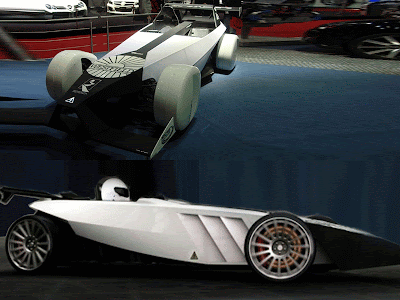
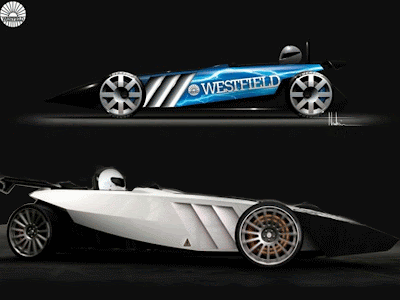
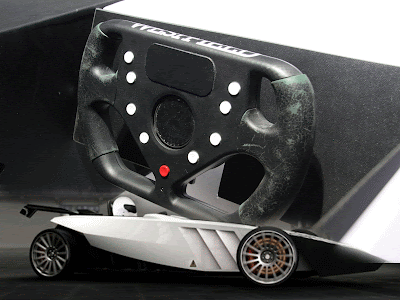
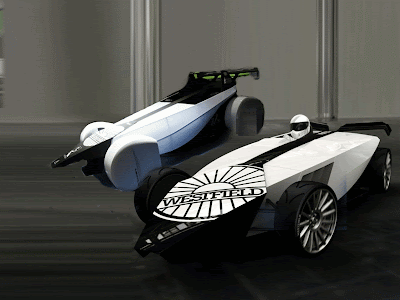
As the exhibitors at Geneva report the Westfield iRacer represents 99% of the production model. Designed by Elliott Hawkins, a graduate from the Royal College of Arts vehicle design course, the iRacer has the pulse of electric power running through its veins. A number of materials including aluminum and recyclable plastics were used for body construction.
iRACER Electric Race Car Westfield Sports Cars Concept
Westfield iRacerReduced fuel consumption and lower emissions are what’s seen a lot these days on the latest production models and concept vehicles. But don’t think that performance will lag for these green cars.
iRACER Electric Race Car Westfield Sports Cars Concept
One prime example is Westfield Sportscars’ iRACER, an all-electric race car created to win competitions. The car’s designer is Elliott Hawkins, a graduate from the world renowned Royal College of Arts vehicle design course. Westfield Managing Director, Julian Turner said that the concept has a bold look and is “99% representative” of the production vehicle. The iRACER uses the following materials: composites, aluminum, recyclable plastics and a stretched lycra skin over an aluminum framework. As a result, the car’s body is lightweight, low-cost, and aerodynamically efficient. Project Manager, Paul Faithfull, said that some materials (like fabric) has major benefits for racing but is obviously unfit for road use. When in a race, it’s of value that the bodywork can change in a few minutes, and that changing the color and sponsors, as well as repairs can be done quickly.
iRACER Electric Race Car Westfield Sports Cars Concept
Created in conjunction with project partners Potenza Technology, Delta Motorsport, RDM Automotive and Coventry University, the iRACER has a 40 kilowatt YASA motor directly turning each rear wheel, which together are said to be good for 200 horsepower at peak output and provide 737 pound feet of torque (1000 Newton meters). Race range is thought to be 50 to 60 miles. As well as a bit of wind tunnel tuning, the team plans to develop independent power delivery to the wheels in an effort to improve performance on the track. Perhaps more controversially, they also intend to devise a new noise generation system that might "give the iRACER aural drama to match both its looks and performance."
iRACER Electric Race Car Westfield Sports Cars Concept
"The use of materials such as fabrics has limited scope for road use, but has major benefits for racing," says Paul Faithfull, iRacer project manager. "Imagine being able to change your bodywork in a matter of minutes, with a new body stretched over the framework, changing the colour, sponsors or just effecting rapid repairs. It is also extremely light compared to almost all alternative materials."
iRACER Electric Race Car Westfield Sports Cars Concept
The concept weighs 600kg (1,323 lbs), is 3.6 metres long and is rear-wheel-driven. Its Lithium Phosphate battery helps the motor make 80kW (109 PS) and 1,000Nm at the wheels. The 0 - 60mph sprint is said to take under 5 seconds and top speed is limited to 177km/h. Westfield reckons a race range of between 80km and 97km (50 and 60 miles) is possible.
iRACER Electric Race Car Westfield Sports Cars Concept
The iRacer will make its racing debut at the EV Cup one-make race car series launching in 2011.

E-Commuter design by Ho-young Joo, Soo-han Cho and JinSeok Song Solar-powered Vehicle

The team members, all majoring in industrial design, belong to the CLOTHO, which is a transportation design study group at SNUT (Seoul National University of Technology). We always try to challenge many international competitions for enhancing our talent.
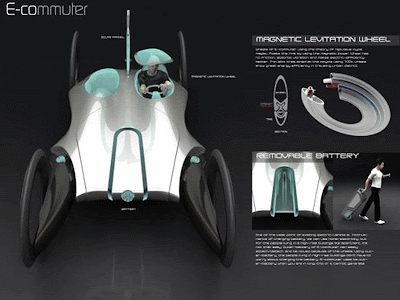
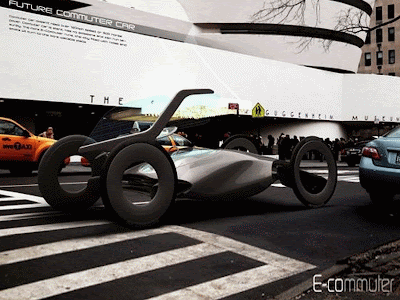
The brainchild of designers Ho-young Joo, Soo-han Cho and JinSeok Song, the E-Commuter is what the streets of today will need for a green tomorrow. The concept has been designed to reduce air pollution that is caused by running vehicles on conventional fossil fuel engines. Ho-young Joo, 25, is now working in his internship at LG Electronics. He is a two-time finalist for Michelin Challenge Design. Soo-han Cho, 23, is currently doing his military requirement.
E-Commuter Solar-powered Vehicle
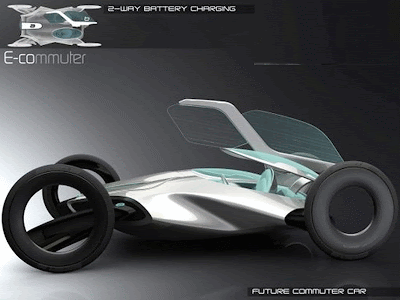
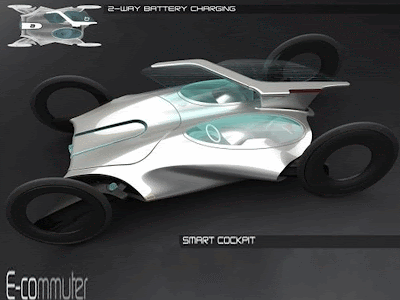
This next-generation concept vehicle will run clean on electricity, which will be provided by onboard solar panels. These solar panels will automatically track the sun and align themselves for maximum solar exposure. Energy generated by these panels will be stored in a battery.
Suffering extreme traffic congestion, the number of people using cars to commute is increasing. The exhaust from vehicles causes serious air pollution and deteriates the supply of fossil fuel. The next generation car should be a complete electric vehicle over the hybrid concept by using sustainable energy sources.
E-Commuter Solar-powered Vehicle
E-Commuter uses two kinds of cells. Using Photovoltaic power generation to charge the upper solar cell, and the insufficient energy of E-commuter can be supplied by Outer-battery. The outer-battery of E-commuter can easily attach/detach and be moved because of the wheels. E-commuter uses its outer-battery when you are in long-trip or it cannot generate energy so much because of the low amount of sunshine. The wheels of E-commuter uses the theory of repulsive-type maglev float by using the magnetic power. The wheel has no friction, it absorbs vibration and makes the electric-efficiency better. Thin slick tires aimed at the bicycle using 700c wheels show great energy efficiency in traveling through urban districts.
E-Commuter Solar-powered Vehicle
If the solar battery depletes and is not able to recharge itself, the vehicle also has a backup battery that can be recharged from a wall socket. The wheels of the E-Commuter absorb vibration and reduce friction for better efficiency. The designers believe that the E-Commuter will be able to hit a speed of up to 120mph, without clogging the streets with toxic smoke.

2010 Hyundai i-Flow Concept Diesel-Electric Hybrid Powertrain

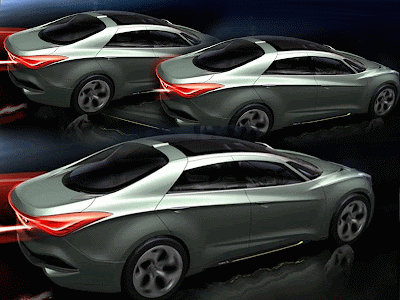
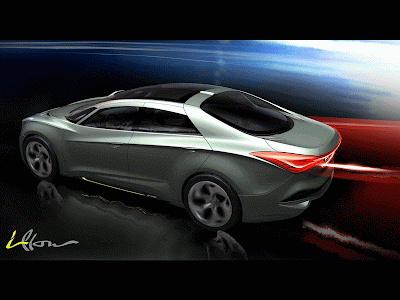
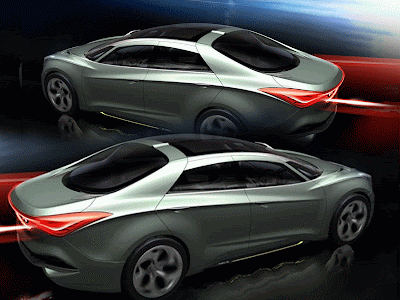
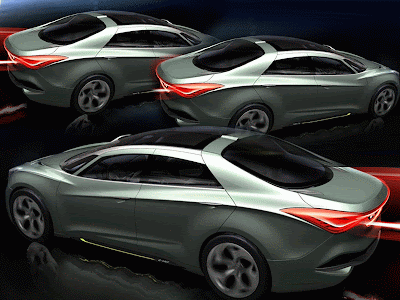
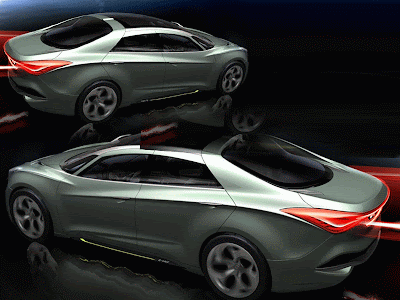
The Geneva Motor Show is quite generous in reveals this year, considering the trend of the automotive industry. Hyundai has just presented its new i-Flow Concept on the catwalk, continuing the company’s statement of developing a the “fluidic design”. As Hyundai continues to branch out into new segments, its European operation, which until recently has focused primarily on small cars, is debuting the Hyundai i-flow concept in Geneva. It's a vision of a coming Hyundai that's expected to do battle in Europe's larger D-segment.
2010 Hyundai i-Flow Concept Diesel-Electric Hybrid Powertrain
The i-flow is the latest concept to wear Hyundai's "fluidic sculpture" design language, and the large D-segment sedan wears it well. Hailing from Hyundai's European Design Headquarters in Russelsheim, Germany, the i-flow incorporates lightweight materials and solar cells from supplier BASF meant to reduce weight and increase energy efficiency.
2010 Hyundai i-Flow Concept Diesel-Electric Hybrid Powertrain
The i-flow is fitted with Hyundai's first-ever diesel hybrid drivetrain, in which a 1.7-liter diesel engine with dual-stage turbocharging is mated to Hyundai's Blue Drive hybrid system and a new six-speed dual-clutch gearbox. As we understand it, the i-flow is a parallel hybrid, allowing it to be powered by its lithium-polymer battery pack and electric motors, the diesel engine or a combination of both. Combined with a slippery 0.25 coefficient of drag, the i-flow will reportedly return 78.4 mpg and emit 0.30 grams of CO2 per mile.
2010 Hyundai i-Flow Concept Diesel-Electric Hybrid Powertrain
The new lines give an elegant avant-garde look, helping in the same time in reducing the CO2 emissions to 85g/km and improving its aerodynamics. In collaboration with chemical company BASF, Hyundai produced its first eco-friendly diesel hybrid powertrain, using high-technologies and next-generation materials. The new i-Flow combines perfectly the concept of a little-big car, as it shows a sporty looks but also provides quite enough space due to the use of a minimalistic design for the seats and center console.
2010 Hyundai i-Flow Concept Diesel-Electric Hybrid Powertrain
The high-tech engine presents the new 1.7-litre engine fitted with 2-stage turbocharging connected to a Lithium Ion-Polymer battery for a more efficient consumption, especially when driven i-flow’s six-speed, dual-clutch transmission. The i-Flow technology is a test bed for new energy harvesting ideas, ranging from flexible solar panel roofing to a thermo-electric generator which uses exhaust heat to produce power. More news of Hyundai’s star cars will be published in advance of the show and will be available on the stand.  The company’s press conference will take place in Hall 1 at 14:15 (CET) on Tuesday 2nd March  (2010).